
Start With How Credit Cards Really Work
A credit card is a financial tool issued by a bank or credit union that allows you to borrow money up to a set limit to make purchases. Unlike a debit card, which draws directly from your checking account, a credit card extends a line of credit that you repay over time — ideally in full each month to avoid interest charges.
Credit cards serve multiple purposes beyond simple purchasing power. They help build your credit history, offer consumer protections, and can earn valuable rewards on everyday spending. Understanding how they work is the first step toward using them to your advantage.
Pick the Card Type That Fits Your Goal
Cash Back Cards
Cash back cards return a percentage of your spending as a statement credit, direct deposit, or check. Typical rates range from 1% to 5% depending on the spending category. Flat-rate cards offer the same percentage on all purchases, while tiered cards give higher rates for specific categories like groceries, gas, or dining.
Best for: People who want straightforward value without tracking points or miles.
Travel Rewards Cards
Travel cards earn points or miles redeemable for flights, hotel stays, rental cars, and other travel expenses. Premium travel cards often include perks like airport lounge access, travel insurance, Global Entry or TSA PreCheck fee credits, and no foreign transaction fees.
Best for: Frequent travelers who can maximize the value of travel-specific perks and sign-up bonuses.
Balance Transfer Cards
These cards offer a 0% introductory APR on balance transfers for a set period — typically 12 to 21 months. This lets you move high-interest debt from another card and pay it down without accruing additional interest. Most charge a one-time transfer fee of 3%–5%.
Best for: People carrying balances on high-interest cards who want to accelerate debt payoff.
Secured Credit Cards
Secured cards require a refundable cash deposit that typically equals your credit limit. They're designed for people with poor credit or no credit history. After a period of responsible use — usually 6 to 12 months — many issuers will upgrade you to an unsecured card and return your deposit.
Best for: People building credit for the first time or rebuilding after negative events.
Student Credit Cards
Student cards are tailored for college students with limited or no credit history. They typically have lower credit limits and offer benefits like good-grade rewards, no annual fees, and educational resources about credit management.
Best for: College students who want to start building credit early.
Business Credit Cards
Business cards help separate personal and business expenses, offer higher credit limits, and provide rewards on common business spending categories like office supplies, telecommunications, and travel. Some offer employee cards with customizable spending limits.
Best for: Small business owners and freelancers who want to manage and earn rewards on business expenses.
Understand the APR Before Rewards Distract You
APR stands for Annual Percentage Rate — the yearly cost of borrowing expressed as a percentage. Credit card APRs are variable, meaning they fluctuate based on the prime rate set by the Federal Reserve.
Here's what you need to know:
- Purchase APR — The rate charged on purchases if you carry a balance past the grace period (usually 21–25 days after your statement closes).
- Balance Transfer APR — The rate applied to balances transferred from other cards. Often 0% for an introductory period.
- Cash Advance APR — The rate charged when you withdraw cash using your credit card. Typically higher than the purchase APR, and interest starts accruing immediately with no grace period.
- Penalty APR — A higher rate triggered by late payments. Can reach 29.99% and may apply to all balances, not just the late payment.
The simplest way to avoid paying interest entirely: pay your full statement balance by the due date every month.
Build Credit With the Habits Issuers Watch
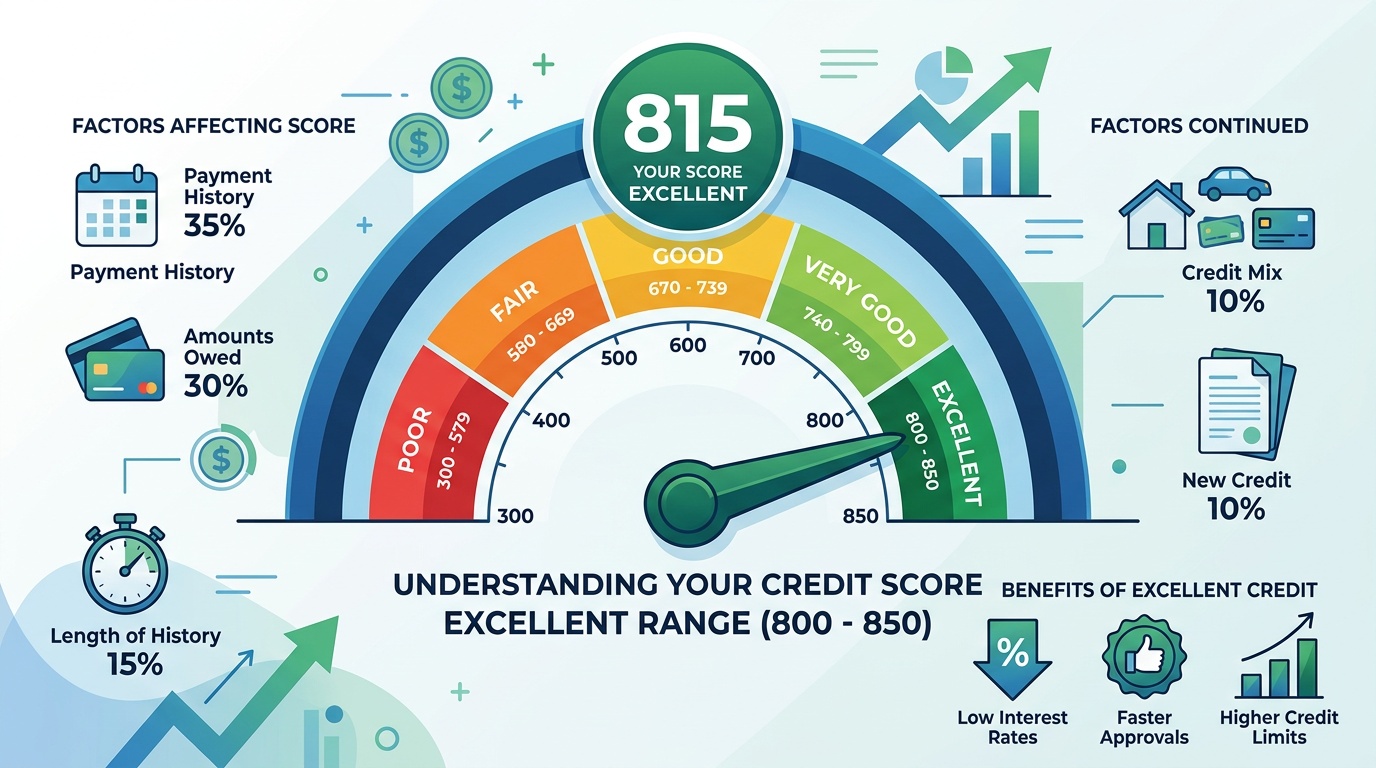
Your credit score is built from five main factors, each weighted differently:
- Payment History (35%) — The most important factor. Even a single missed payment can drop your score significantly. Set up autopay for at least the minimum payment to protect against this.
- Credit Utilization (30%) — The percentage of your available credit you're using. Keep it below 30%, and ideally under 10%, for the best score impact.
- Length of Credit History (15%) — The average age of your accounts. Older accounts help. This is why keeping your first credit card open — even if unused — can benefit your score.
- Credit Mix (10%) — Having different types of credit (cards, auto loans, mortgage) shows lenders you can manage diverse obligations.
- New Credit (10%) — Hard inquiries from applications temporarily lower your score. Space out applications by 3–6 months.
Actionable Steps to Raise Your Score
- Pay all bills on time — set up autopay or calendar reminders.
- Pay down existing balances to reduce utilization.
- Request credit limit increases on existing cards (this lowers utilization without adding new accounts).
- Become an authorized user on a family member's old, well-managed card.
- Check your credit report for errors and dispute any inaccuracies.
- Avoid closing old accounts unless they have high annual fees you can't justify.
Get More Value From Rewards Without Overspending
Getting the most value from your credit cards requires a deliberate strategy. Here are proven approaches:
Category Optimization
Use different cards for different spending categories. A card that earns 3% on groceries paired with one earning 5% on gas and 2% on dining can significantly outperform a single flat-rate card.
Sign-Up Bonus Stacking
Sign-up bonuses are the single most valuable feature of premium cards. A $750 travel bonus dwarfs the value you'd earn from regular spending in a typical year. Plan new card applications around periods of high spending — holiday shopping, home renovations, or planned travel — to meet bonus thresholds naturally.
Statement Credit vs. Travel Redemption
Many travel cards offer higher per-point value when redeemed through their travel portal versus a statement credit. For example, points might be worth 1 cent each as a statement credit but 1.5 cents each when redeemed for travel. Always check your redemption options before cashing in.
Frequently Asked Questions
Yes, whenever possible. Paying in full avoids interest charges entirely and keeps your utilization low. If you can't pay the full balance, always pay more than the minimum to reduce interest costs and pay down the balance faster.
Not necessarily. Multiple cards can increase your total available credit (lowering utilization) and diversify your rewards. However, managing more accounts requires discipline. Only open cards you'll actively use and can track.
Call your issuer immediately to freeze or cancel the card. Most issuers have 24/7 phone lines for this purpose. Review recent transactions for unauthorized charges and dispute any you don't recognize. A replacement card is typically issued within 3–5 business days.
It depends on your spending and lifestyle. If you travel at least 2–3 times per year and can use airport lounges, travel insurance, and transfer partners, a travel card often provides more value. If you prefer simplicity and guaranteed value, cash back is hard to beat.
Yes. If you have a good payment history with the issuer, call and ask for a rate reduction. Having a competing offer from another issuer strengthens your request. Issuers would rather lower your rate than lose you as a customer.